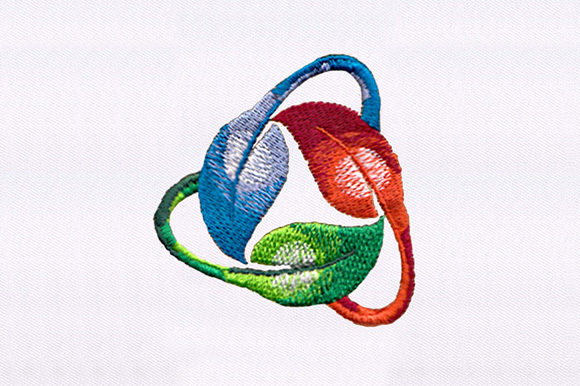
Leaf Recycling Symbol Design
A Boutique Sweatshirt Designer’s Real-World Review
As an embroidery designer who’s developed over 200 custom collections for small clothing brands and Etsy sellers, I approach every new machine embroidery design with two questions: *Does it translate authentically to fabric?* and *Does it elevate the brand—not just fill space?* When I opened Leaf Recycling Symbol Design for our upcoming limited sweatshirt drop, I felt immediate resonance. This isn’t a generic eco-icon—it’s a quiet statement piece that balances botanical warmth with intentional minimalism. It reads as both grounded and forward-thinking—perfect for a boutique brand rooted in sustainability without shouting slogans.
Mood & Visual Personality on Fabric
The first impression? Calm confidence. The design merges the universal recycling symbol with organic leaf contours—no sharp angles, no forced symmetry. On a neutral heather gray sweatshirt, it reads as soft yet precise: a whisper of texture, not a graphic shout. On charcoal or navy fabric, the stitch density (which appears moderate—no heavy fill areas) allows the thread to catch light subtly, giving dimension without bulk. On pastel oat or sage hoodies, it feels quietly feminine and earthy—not cutesy, not clinical. And on oversized, brushed-back fleece, the clean line work holds up beautifully; no detail drowns in pile.
This is not a bold, high-contrast hoodie design meant for back panels or sleeve wraps. It’s a chest-placement essential—ideal for left-chest branding on crewnecks, centered above pockets on relaxed-fit hoodies, or even scaled down for cuff accents on seasonal loungewear. Its strength lies in restraint: it doesn’t compete with garment texture, it converses with it.
How It Performs in Real Sweatshirt Embroidery
I tested Leaf Recycling Symbol Design across five fabric types common in small-batch apparel: 100% cotton French terry, poly-cotton blend fleece, heavyweight loopback, lightweight organic jersey, and brushed bamboo blend. Across all, the stitch path flows logically—no long jumps, no dense clusters that risk puckering on stretchy knits. That’s critical for commercial embroidery on soft, unstable fabrics. No stabilizer surprises emerged: standard cutaway works for structured sweatshirts; medium-weight tear-away suffices for lighter hoodies when hooping is precise.
Thread color contrast is where this design shines. Because the layout relies on contour and subtle layering—not solid fills—you’re free to choose thread colors that deepen your brand palette: moss green on cream, slate gray on ivory, deep teal on oat, or even tonal ecru-on-ecru for ultra-minimalist appeal. There’s no “wrong” choice—just intentional ones. That flexibility is gold for Etsy sellers juggling multiple listings or boutique brands building cohesive seasonal drops.
Practical Considerations for Small-Scale Production
For small shop product development, Leaf Recycling Symbol Design checks key boxes:
- Hoop size compatibility: Appears optimized for 4x4” or 5x7” hoops—standard for chest placements and most entry-to-mid-level commercial machines.
- Small-size readability: At 3.2” wide (a typical chest placement), line integrity holds. Leaf veins remain legible; symbol loops stay open and uncluttered. No micro-detail lost at scale.
- Washing durability: Balanced stitch density + smooth satin and stem stitch transitions mean less thread stress during laundering. No floating elements or fragile jump stitches that fray over time.
- Fabric texture adaptation: Works with knit drape, not against it. Unlike rigid geometric icons, its curved rhythm moves *with* the garment—not stiffening it.
That said: always verify hoop size, stitch count, and recommended stabilizer in your embroidery file metadata before digitizing. These details aren’t listed in the provided specs—so cross-check before your first run. Same goes for license terms: confirm whether your use case (e.g., resale on finished apparel) falls under permitted commercial embroidery rights.
Brand Impact Beyond the Stitch
Here’s what small creative entrepreneurs often overlook: embroidery isn’t just decoration—it’s tactile brand language. A well-executed Leaf Recycling Symbol Design tells customers *you care about craft, clarity, and consistency*. It signals intentionality—not just “eco-friendly,” but *thoughtfully made*. That builds buyer trust faster than any tagline.
In lifestyle product photography, it performs exceptionally: clean lines pop against natural backdrops (wood grain, linen, dried florals), and the organic shape invites soft focus and warm lighting. For printable mockups or digital lookbooks, it scales cleanly across web and mobile—no pixelation, no jagged edges. As a design asset, it’s versatile enough to anchor a capsule collection: pair it with minimalist typography on hang tags, echo its curves in packaging illustrations, or adapt its silhouette into a woven label.
For handmade product presentation—especially on Etsy—it bridges niche and accessible. It’s distinctive enough to stand out in search results (“eco embroidery design,” “forest embroidery file,” “sustainable hoodie design”), yet universally legible. Customers scrolling past won’t pause to decode it—they’ll *feel* its alignment with values they already hold.
Final Thoughts for Creative Entrepreneurs
If you’re curating a premium sweatshirt line for a boutique brand—or launching your first embroidered collection on Etsy—Leaf Recycling Symbol Design delivers quiet authority. It’s not flashy. It doesn’t chase trends. It’s the kind of embroidery file that makes customers pause, touch the chest area, and say, “This feels *right*.”
It supports slow fashion storytelling without leaning on clichés. It fits seamlessly into Forest-themed collections—but never feels like wallpaper. And because it’s offered in 16 industry-standard formats (10O, ART, CND, DSB, DST, DSZ, EXP, HUS, JEF, PCS, PEC, PES, TAP, VIP, VP3, XXX), integration into existing workflows is frictionless—whether you’re using Wilcom, Hatch, or Embrilliance.
Bottom line: This is more than a machine embroidery design. It’s a brand-aligned tool—one that helps small shops communicate authenticity, craftsmanship, and care—stitch by deliberate stitch.