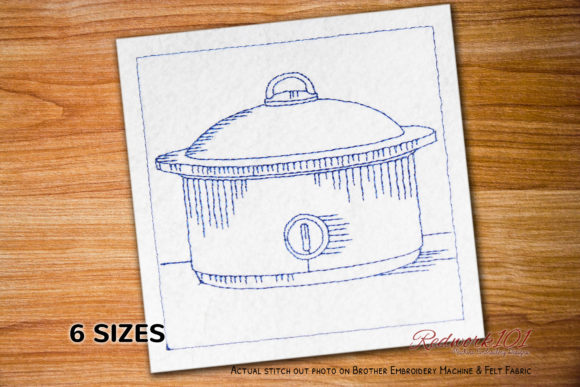
Crock Pot Redwork
Why This Design Fits Real Small-Business Needs
As someone who’s stitched, listed, and shipped hundreds of embroidery designs for Etsy and local craft fairs, I approached Crock Pot Redwork with a very practical question: *Does this feel like something customers will actually buy—and love—on a finished product?* The answer is yes—but not everywhere. Its charm lies in specificity. It’s warm, nostalgic, and quietly confident—not flashy, not trendy, but deeply resonant for buyers who appreciate handmade kitchen charm or cozy home storytelling.
A Visual Personality That Sells
Crock Pot Redwork reads as rustic-modern with a classic redwork foundation. It’s not overly detailed or delicate, which means it holds up beautifully on textured fabrics like terry cloth, canvas, and cotton twill. It feels friendly, approachable, and just a little bit whimsical—without tipping into cartoonish. That balance makes it ideal for handmade product lines that aim for authenticity over algorithm-chasing. Think less “viral TikTok trend” and more “the apron your friend gifts you after your first big dinner party.”
Where Crock Pot Redwork Shines on Finished Goods
This isn’t a one-size-fits-all embroidery file—it thrives where function meets feeling:
- Kitchen towel embroidery: Instant warmth in a utilitarian item. Redwork pops against natural linen or cream cotton, and the crock pot motif signals care, comfort, and slow living.
- Embroidered patch: Perfect for iron-on or sew-on use on denim jackets, tote bags, or aprons. Its clean outline and moderate detail make it stable at 3"–4" sizes—ideal for small-batch merch.
- Baby embroidery and personalized gift applications: Pair it with soft flannel blankets or bibs. It reads gentle and timeless—not babyish, not generic. Great for “first kitchen” or “new home” gift bundles.
- Tote bag design and sweatshirt embroidery: Works especially well centered on the chest or lower front panel. The redwork style avoids looking heavy or dense, so it breathes nicely on knit or woven apparel.
- Small batch apparel and handmade home decor: Pillow covers, tea towels, oven mitts—anything that lives in the domestic sphere benefits from its grounded, inviting energy.
How It Supports Your Creative Workflow
Crock Pot Redwork is low-friction for production. The note about “The Box Stitch shown in picture is optional” tells me this design was built with flexibility in mind. You can simplify it further by skipping the outer box entirely—or swap thread colors to match seasonal palettes (think sage + cream for spring, navy + brick for fall). That adaptability saves time when prepping multiple listings or rotating inventory.
It also lends itself well to printable mockup creation. Because the shape is compact and balanced, it photographs cleanly—even at thumbnail size on Etsy. That means stronger visual consistency across your shop, faster product photography sessions, and social media previews that communicate value without text overload.
Buyer-Focused Value You Can’t Fake
What makes Crock Pot Redwork commercially smart isn’t just how it looks—it’s how it makes the buyer *feel*. Customers browsing for a personalized gift or custom apparel are often seeking emotional resonance. A crock pot says “I made this for you,” “This home is loved,” or “Slow down and savor.” That subtext converts. It helps your finished product feel more memorable, more giftable, and more professionally curated—even when sold alongside mass-produced items.
Plus, because it sits comfortably in the House category while remaining distinctly handmade, it stands out in Etsy search results without needing aggressive keyword stuffing. It’s niche enough to avoid oversaturation, broad enough to attract multiple buyer intents—from wedding registries to teacher appreciation gifts.
Practical Seller Notes Before You List
Before adding Crock Pot Redwork to your next batch of Etsy seller listings, take these steps:
- Test the design first. Run a sample stitch-out on your most common fabric/stabilizer combo—especially if using it on towels or knits. Check for puckering or thread breaks around curves.
- Photograph it on real fabric. Don’t rely solely on digital mockups. Natural light, texture, and drape change how redwork reads. A crisp photo builds trust faster than any description.
- Compare thread color options. Redwork traditionally uses matte red, but try burgundy, rust, or even deep olive for boutique differentiation. Note which version photographs best at thumbnail size.
- Review stitch density. Is it light enough for lightweight fabrics? Heavy enough to read clearly on textured surfaces? If unsure, check the Creative Fabrica product page for notes—or stitch a 2" version to assess coverage.
- Confirm hoop size and machine compatibility. Some redwork files require precise alignment or multi-hooping. Don’t assume—verify before committing to a full run.
- Check Creative Fabrica licensing. Since this is a digital embroidery file, ensure the license permits commercial use for finished product sales. Most do—but always reconfirm before listing.
Final Thought: A Quietly Strategic Addition
Crock Pot Redwork won’t dominate your homepage—but it might become your most consistently reordered design. It’s the kind of piece that earns repeat customers, gets tagged in Instagram stories, and shows up in “small shop favorites” roundups. For craft business owners building intentional, scalable collections, it’s not filler. It’s foundation. Use it where warmth matters, where utility meets heart, and where your handmade product needs to say more than just “made with love”—but exactly that, too.